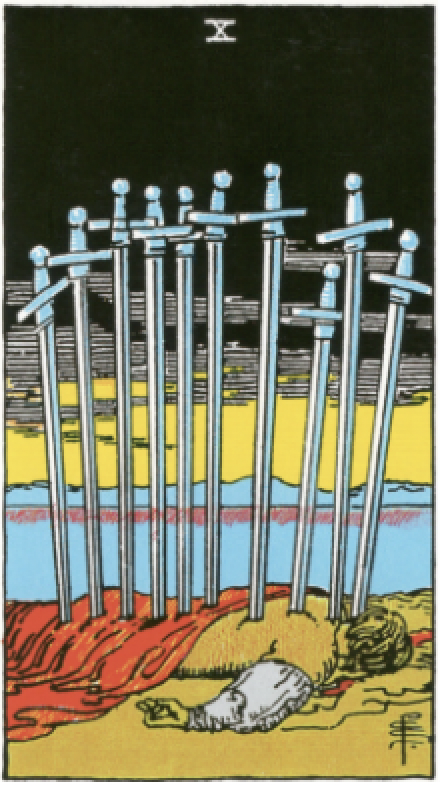
Ten of Swords
It feels final. But endings often look harsher than they are.
It is over, and it is not the catastrophe it feels like. The dramatic version lets you avoid the plain one: this ended, and you are still here.
What it looks like, by what you are asking about
It ended at work, the role, the project, the trust, and it feels total. It is an ending. It is not the end of you.
What actually ended, as opposed to what it feels like ended?
Write the plain version of what happened today, without the adjectives.
The money thing collapsed and you are treating it as the end of everything. It is the end of one plan.
What is still true about your situation that the loss did not touch?
List three of those things today, then take one step from there.
It is over. You keep replaying the ending as a betrayal because a betrayal is at least a story. Sometimes things just end.
What are you adding to the story of this ending that was not actually there?
Tell the ending to one person this week in five plain sentences.
The decision was made by events, and it feels brutal. Brutal is the drama. The fact is smaller and easier to carry.
What is left to decide now that this is settled?
Decide that today, and stop relitigating what is closed.
Something has ended for good and you are lying in it. This is the floor. The floor is where getting up starts.
What are you still hoping might not have happened?
Say the sentence it happened out loud today, once, without softening it.
The project is dead. You are mourning it as a tragedy when it is a piece that did not work, which is most pieces.
What did this one teach you that the next one can use?
Write that in three lines today, then close the folder.
The rest of the deck
- The Fool
- The Magician
- The High Priestess
- The Empress
- The Emperor
- The Hierophant
- The Lovers
- The Chariot
- Strength
- The Hermit
- Wheel of Fortune
- Justice
- The Hanged Man
- Death
- Temperance
- The Devil
- The Tower
- The Star
- The Moon
- The Sun
- Judgement
- The World
- Ace of Wands
- Two of Wands
- Three of Wands
- Four of Wands
- Five of Wands
- Six of Wands
- Seven of Wands
- Eight of Wands
- Nine of Wands
- Ten of Wands
- Page of Wands
- Knight of Wands
- Queen of Wands
- King of Wands
- Ace of Cups
- Two of Cups
- Three of Cups
- Four of Cups
- Five of Cups
- Six of Cups
- Seven of Cups
- Eight of Cups
- Nine of Cups
- Ten of Cups
- Page of Cups
- Knight of Cups
- Queen of Cups
- King of Cups
- Ace of Swords
- Two of Swords
- Three of Swords
- Four of Swords
- Five of Swords
- Six of Swords
- Seven of Swords
- Eight of Swords
- Nine of Swords
- Page of Swords
- Knight of Swords
- Queen of Swords
- King of Swords
- Ace of Pentacles
- Two of Pentacles
- Three of Pentacles
- Four of Pentacles
- Five of Pentacles
- Six of Pentacles
- Seven of Pentacles
- Eight of Pentacles
- Nine of Pentacles
- Ten of Pentacles
- Page of Pentacles
- Knight of Pentacles
- Queen of Pentacles
- King of Pentacles